The mission of higher education is discovery, creation, and dissemination of knowledge. It is the space where critical thinking is nurtured and encouraged, where talents are developed, and where the workforce of the future is cultivated. Social work education is an integral part of higher education’s mission, the workforce pipeline, and the global socio-cultural-political economy.
Together, we can advocate for policies and regulations that protect the mission of higher education and publicly demonstrate the commitment of social workers and social work educators to the health and well-being of individuals, families, and communities.
Our Advocacy Priorities
CSWE is committed to ensuring integrity is maintained in higher education, particularly as it relates to social work education. This is done in part through the development of thoughtful policy governing accreditation and by monitoring policies and legislation.
In 2025 and 2026, CSWE led the charge in pushing back against the Department of Education's revised definition of "professional degrees," which did not include graduate-level social work degrees. Learn more here.
Download our RISE rule resource for students here.
CSWE advocates on behalf of the Public Service Loan Forgiveness (PSLF) program. PSLF was created in 2007 to encourage students to pursue public service careers. Eligible employees who work at qualifying public service organizations and make 120 on-time monthly payments—which total 10 years of payments—can qualify for loan forgiveness. For professions such as social work, in which wages often are lower compared to other professions, PSLF encourages professionals to pursue opportunities in critical high-need areas.
Social justice is central to the role social workers play in the various communities in which they serve. Social workers advance social justice by helping individuals address their unique needs and challenges by connecting them with necessary resources to help them lead full, healthy, and productive lives.
Social workers are vital to health care in the U.S., and the need for more social workers in healthcare is growing. Social workers make up the largest percentage of the country’s behavioral health workforce. They provide services in a variety of community settings including schools, clinics, hospitals, child welfare agencies, and local, state, and federal agencies.
As one of the largest providers of professional substance use and mental health services in the United States, social workers are in a unique position to serve the millions of Americans battling addiction. If not directly providing substance and mental health treatment, social workers ensure that individuals, families, and communities are linked with these services, and furthermore, address critical gaps in the continuum of care. This is necessary to ensure adequate recovery and minimize relapse among individuals with opioid use disorder (OUD), as well as other substance use and coexisting disorders. In addition, social workers are prepared to address social factors that impact treatment and recovery, such as housing, education, and job security. These needs are often missed in settings that do not involve social work.
Federal funding supports schools and programs of social work by providing student financial aid programs, health professions education programs, mental and behavioral health training efforts, and social and behavioral research initiatives. These federal efforts promote a sustainable, skilled, and culturally competent workforce that keeps pace with the increasing demand for social work services. CSWE communicates with congressional social work champions throughout the annual appropriations process to advocate for robust funding for programs of importance to social work students and schools. Examples include the Pell Grant program, Public Service Loan Forgiveness, Behavioral Health Workforce Education and Training, Scholarships for Disadvantaged Students, Minority Fellowship Program, and National Institutes of Health research initiatives.
RISE Rule Guide for Students
The Department of Education has changed the definition of "professional degrees," removing graduate-level social work degrees from its list. Learn more about the potential impacts for students with our RISE Rule 1-pager.
Our Policy and Advocacy Team
Advocacy Resources
CSWE’s Advocacy Resource Hub provides toolkits, templates, media coverage, suggested reading lists, data, and more, collected for social work educators' educational and advocacy efforts.
Our Advocacy Handbook: A Guide For Social Workers
Eager to make your voice heard but don't know where to start? Download CSWE's Advocacy Handbook! Prepared by our government relations team at Lewis-Burke Associates, the Advocacy Handbook explores frequently asked questions about federal advocacy and outreach, provides a primer on U.S. Congress and Congressional Committees, and gives guidance on how to communicate with your elected representatives.
Anti-DEI Restrictions Updates & Tracker
CSWE and our advocacy partners at Lewis-Burke Associates are tracking legislation and other directives restricting diversity, equity, and inclusion (DEI) in higher education.
Since 2023, 28 anti-DEI bills have become law. These bills tend to focus on restricting DEI offices/staff, DEI training, diversity statements, and identity-based hiring practices. The Chronicle of Higher Education has created two resources to track these legislative efforts:
» Response by Public Colleges to Anti-DEI Legislation
There have been new updates in Arkansas, Iowa, Kansas, North Carolina, and Ohio since our last update:
Arkansas: In November 2024, State Sen. Dan Sullivan, a Republican, introduced a bill that would ban affirmative action by state and local agencies, including public colleges. The bill mirrors SB 71, which Sullivan introduced in 2023 but failed to pass. It was signed into law by Gov. Sarah Huckabee Sanders on February 18, 2025 and was slated to take effect on July 11, 2025. » Senate Bill 3
Iowa: In March 2025, the Iowa House education committee introduced a bill that would ban public entities including state agencies, local governments, and community colleges from preferential hiring, funding DEI offices, or employing DEI officers. (The bill extends the restrictions that were placed on the public four-year colleges in 2024 to the community colleges.) The bill also restricts public colleges from requiring diversity training and having students to enroll in courses that include DEI or critical race theory as part of general-education or graduation requirements. Gov. Kim Reynolds, a Republican, signed the bill into law in May 2025. The bill took effect July 1, 2025. » House File 856
In April 2024, State Sen. Jeff Taylor, a Republican, introduced an amendment to an education appropriations bill that would prohibit public universities from establishing, maintaining, or staffing a diversity, equity, and inclusion office. The bill would also bar public colleges from requiring diversity statements and giving preferential treatment to anyone based on such statements. The bill passed the Senate and the House on the same day, and Gov. Kim Reynolds, a Republican, signed the bill into law on May 9, 2024. It went into effect on July 1, 2025. » Senate File 2435
Kansas: In April 2024, a conference committee agreed to remove the contents of an earlier version of House Bill 2105, which was unrelated to DEI, and replace it with the contents of House Bill 2460. That bill would prohibit public colleges from requiring students or employees to submit diversity statements for admission, hiring, or promotion. The House and Senate both approved the bill, and Gov. Laura Kelly allowed it to become law without her signature. It took effect on July 1, 2025. » House Bill 2105
North Carolina: In February 2025, State Rep. Brenden Jones, a Republican, introduced a bill that would prohibit state agencies, including public institutions of higher education, from using diversity, equity, and inclusion in hiring practices, having DEI offices or staff, or offering diversity training. On July 3, 2025, Gov. Josh Stein, a Democrat, vetoed the bill. » House Bill 171
Ohio: In June 2023, Rep. Jay Edwards, a Republican, introduced into Ohio's two-year state-budget plan several elements of Senate Bill 83, which would ban mandatory diversity, equity, and inclusion trainings, block DEI programs, and prohibit the use of diversity statements in the hiring process. All anti-DEI components had been removed from the budget bill once it reached the House, and the budget was signed by the governor July 1, 2025. » House Bill 33
Social Work is a Professional Degree
The U.S. Department of Education has published its draft definition of "professional" degrees, and social work is not included.
CSWE urged the Department to include social work in its definition before, during, and after the new definition was written. We continue to advocate on behalf of social work students.
Students: Here is a helpful one-pager on where things stand.
Outreach Resources
As social work educators and leaders, CSWE encourages members to contact their members of Congress to express their positions on the proposed cuts to higher education student aid. Visit Congress.gov to identify your members of Congress in both the House and the Senate. Below are advocacy templates provided by CSWE that can be sent to your member of congress through email, postal service, or even by reading the letter to a staff member at your representative's office.
Download: Advocacy message template: This advocacy message template is for the proposed cuts to higher education student aid that were recently approved by the U.S. House Education and Workforce Committee.
Download: Minority Fellowship Program (MFP) Alumni Fact Sheet: This one-page document includes highlights and outcomes of CSWE's Minority Fellowship Program Alumni.
Resources for Community Organizing
- National Education Association’s Fundamentals of Organizing Toolkit
- American Association of University Professors’ (AAUP) Government Relations Toolkit
- American Library Association’s (ALA) The Frontline Advocacy Toolkit
- Faculty Organizing Against CPHE’s Immediate Action Toolkit: A resource for faculty opposing the Commission for Public Higher Education (CPHE), a newly proposed accreditation body being advanced in several Republican-led states. Unlike legitimate accreditors, CPHE was developed to serve the political agendas of state governments rather than the academic needs of institutions, faculty, or students
U.S. Government Resources and Links
- White House: Presidential Actions
- White House: Briefings & Statements
- White House: Fact Sheets
- U.S. Senate legislation website
- U.S. House of Representatives website
- Congress.gov: Provides current and past legislative activities for both Congressional bodies
- Congressional Budget Office
- Supreme Court of the United States
- SCOTUSblog: Coverage of Supreme Court actions and decisions
- Justia: Free access to federal and state court decisions, codes, and regulations
Data Resources
Additional Advocacy Resources
Fellows Forum on the Hill
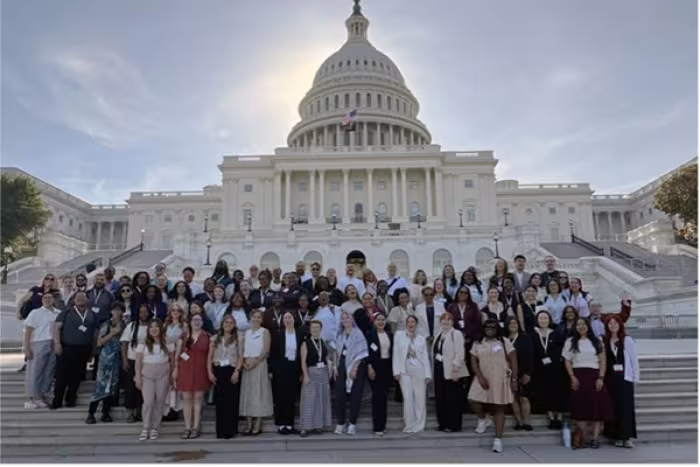
In May 2026, CSWE hosted dozens of social work students for a two-day convention that culminated in a visit to lawmakers at the U.S. Capitol.
Policy Briefs
Below, catch up on news that impacts the social work education community from our team on Capitol Hill. CSWE Policy Briefs are released on a continuous basis and are grouped here by month.