WASHINGTON, DC—The Council on Social Work Education (CSWE) convened a policy briefing and panel discussion on the impact of artificial intelligence (AI) in social work education and practice, specifically within the context of mental health and social services.
The event, which took place on Tuesday in the Cannon House Office Building on Capitol Hill, was attended by social work leaders and congressional staff.
“AI isn’t ‘coming soon’ to social work education and practice, it’s already here,” said Dr. Desmond Upton Patton of the University of Pennsylvania, who presented a brief keynote address prior to the panel discussion. “And while technology can help recognize and identify patterns, it’s people who give meaning to those patterns. Social workers should be called upon to shape the development of AI because social workers are the best equipped to explain how AI should interact and engage with people.”
Dr. Patton implored members of Congress to invest more funding into research on the intersection of AI and mental health, to engage communities in measuring the social impact of AI tools, and to accelerate efforts to increase oversight and regulation of this emerging technology.
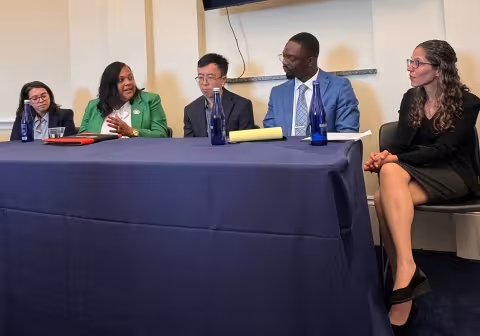
Panelists discuss the risks and rewards of AI in social work education and practice at CSWE's AI policy briefing on Capitol Hill. From left, Dr. Marina A. Badillo-Diaz, Dr. M. Sebrena Jackson, Dr. Ruopeng An, Emmanuel Adaranijo, and Dr. Tova Walsh.
The panel discussion that followed featured experts from across the social work continuum. Joining moderator Dr. Tova Walsh were Emmanuel Adaranijo, Dr. Marina A. Badillo-Diaz, Dr. M. Sebrena Jackson, and Dr. Ruopeng An. The experts tackled questions about AI’s risks and rewards, how this technology is already impacting education and practice, and how lawmakers should lead in this pivotal and changeable moment.
“We’re already seeing social workers using AI tools to support grant writing and grant research,” said Dr. Badillo-Diaz, a social work professor and the founder of The AI Social Worker, an initiative focused on advancing responsible and ethical AI usage across the profession. “It’s giving them time back to do more client-facing work.”
Dr. An, a professor at New York University, underscored those efficiency gains. “What we are seeing so far is that AI is not replacing the workforce,” he said. “It’s giving people power to automate some tasks while freeing up time to do more valuable and impactful work.”
Each panelist also acknowledged the risks posed by AI and similar emerging technologies. Adaranijo, a doctoral candidate at the University of Albany, mentioned the high-profile cases of two teenagers who died by suicide after troubling, extended interactions with AI chatbots. He called for investment in new AI tools and functionality to be balanced by equal investments to protect at-risk populations.
CSWE’s 2026-2030 strategic plan challenges the organization to examine and explore the implications and opportunities AI presents to social work education and the profession. Events like this one underscore CSWE’s commitment to leadership in this area.
CSWE Honors Rep. Bonnie Watson Coleman
At the close of Tuesday’s event, CSWE presented its Distinguished Leadership Award for Social Work Education to Rep. Bonnie Watson-Coleman (D-NJ) for her steadfast leadership and advocacy on behalf of social work students, faculty, and the social work profession.
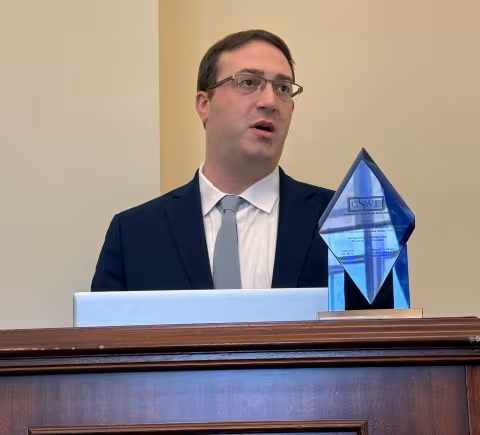
Brad Korten, Senior Advisor for Rep. Watson-Coleman, accepts CSWE's Distinguished Leadership Award for Social Work Education on behalf of Rep. Bonnie Watson-Coleman (D-NJ).
Rep. Watson Coleman, who announced that she would not seek reelection this year, has served New Jersey’s 12th district since January 2015. She was the first Black woman elected to the House of Representatives from New Jersey.
Watson Coleman has been instrumental in securing financial support for students pursuing a career in social work, including funding from the U.S. Department of Health and Human Services and the Substance Abuse and Mental Health Services Administration. This funding has supported generations of Minority Fellowship Program scholars, who have gone on to serve vulnerable and at-risk groups in communities across the United States and its territories.
Brad Korten, Senior Advisor for Rep. Watson-Coleman, accepted the award on her behalf.